
For many teams building Software as a Medical Device (SaMD), one of the first challenges is figuring out how to organise software verification activities in a clear and manageable way. That’s where your Software Verification plan comes in.
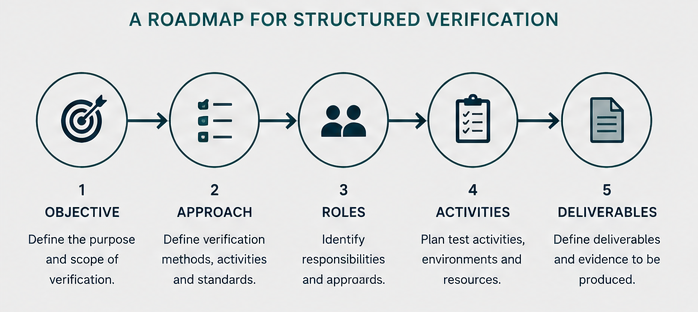
A Software Verification Plan (SVP) is commonly used to define:
- what verification activities will be performed,
- how testing will be approached,
- who is responsible,
- and what evidence will be produced during the verification process.
For small teams, an SVP can act as a lightweight roadmap that helps keep verification activities structured and consistent throughout development.
Why Use a Software Verification Plan?
Without a clear verification structure, teams can quickly run into problems such as:
- inconsistent testing approaches,
- unclear ownership,
- missing evidence,
- duplicated work,
- or gaps between requirements and testing activities.
A Software Verification Plan helps establish a shared process before testing begins.
Even lightweight Class A SaMD projects can benefit from having:
- defined testing approaches,
- documented responsibilities,
- and consistent verification records.
Looking for a simple starting point?
Download the free Lightweight SaMD Verification Checklist to help plan, prepare, execute, and review software verification activities with confidence.
What Does an SVP Typically Include?
The exact structure varies between organisations, but a Software Verification Plan may commonly include sections such as:
- document purpose and scope,
- verification approach,
- testing methodology,
- test environments,
- entry and exit criteria,
- defect management processes,
- and verification deliverables.
Some teams may also include:
- revision history,
- approval tracking,
- or lightweight traceability references.
Verification Activities in Small Teams
Not every SaMD team operates with a large Quality Management System or dedicated QA department.
For startups and smaller engineering teams, the goal is often to create documentation workflows that are:
- understandable,
- maintainable,
- and appropriately scaled to the project.
A lightweight SVP can help teams:
- define how testing will be managed,
- organise verification activities,
- and maintain clearer documentation throughout development.
Common Mistakes When Creating an SVP
Some common issues small teams run into include:
- overcomplicating the process,
- copying enterprise-level documentation unnecessarily,
- creating documents no one actually uses,
- or writing verification plans that are disconnected from real engineering workflows.
In practice, the most effective verification plans are often:
- practical,
- concise,
- and aligned with how the team actually works.
Final Thoughts
A Software Verification Plan doesn’t need to be overly complex to be useful.
For many Class A SaMD teams, a lightweight and well-structured verification plan can provide enough organisation and consistency to support practical software verification activities without creating unnecessary overhead.
The best documentation workflows are usually the ones that teams can realistically maintain as their software evolves.