
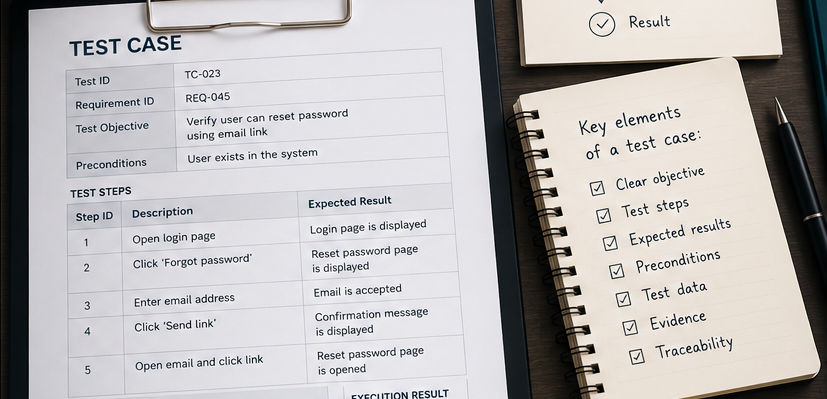
One of the fastest ways for software verification activities to become painful is inconsistent test case structure.
Early in a project, test documentation often feels manageable. There may only be a handful of requirements and a small number of tests. But as projects grow, inconsistencies start to accumulate. Some test cases contain detailed execution steps, others only a sentence or two. Requirement references go missing. Verdicts are recorded differently by different team members. Generating verification summaries becomes increasingly manual.
I’ve seen projects where answering a seemingly simple question – “Which requirements have been verified?” – required hours of spreadsheet work.
A consistent test case structure won’t solve every verification challenge, but it can dramatically reduce friction as projects scale.
For small SaMD teams, verification activities often evolve organically. What starts as a practical spreadsheet or document can quickly become difficult to maintain as requirements, features, and testers multiply.
The symptoms are usually familiar:
- Missing requirement links
- Inconsistent verdicts
- Duplicate tests
- Manual reporting effort
- Difficulty demonstrating coverage
None of these issues are particularly serious on their own. The challenge is that they compound over time.
By the time a project contains dozens or hundreds of test cases, small inconsistencies can become expensive. Teams may find themselves struggling to answer seemingly simple questions: Which requirements have been verified? Which tests failed? What evidence supports each result? What remains outstanding?
When those answers aren’t readily available, verification activities become slower, reporting becomes more manual, and confidence in coverage can begin to erode.
Core Elements of a Practical Test Case
In my experience, the best test cases are not the most detailed – they’re the most consistent.
A practical test case typically includes a few core elements.
Test Identifier
Every test should have a unique identifier.
Examples:
- TC-001
- SYS-005
- INT-023
Consistent identifiers make traceability and reporting significantly easier later in the project.
Linked Requirement
Where possible, link tests directly to software requirements.
Example:
- Requirement: SYS-REQ-014
- Test: TC-007
Even lightweight traceability provides enormous value when generating reports or reviewing coverage.
Test Objective
The objective should clearly describe what is being verified.
Instead of:
Verify login.
Go with:
Verify that users with valid credentials can successfully authenticate and access the dashboard.
The objective should describe expected behaviour rather than implementation details.
Preconditions
Document any setup required before execution.
Examples:
- User account exists
- Device is connected to the network
- Sample patient data has been loaded
Clear preconditions reduce ambiguity and improve repeatability.
Execution Steps
Execution steps should be specific enough that another tester could reproduce the activity.
Example:
- Launch the application.
- Enter valid credentials.
- Select “Login”.
- Observe system behaviour.
If different testers consistently achieve different outcomes, the test case likely needs refinement.
Expected Results
Expected outcomes should be objective and observable.
For example:
The dashboard loads successfully and the authenticated user’s profile information is displayed.
Avoid vague outcomes such as:
The system works correctly.
Execution Verdict
Standardising verdicts makes reporting much easier.
Common verdicts include:
- Pass
- Fail
- Not Run
- Skipped / N/A
Once verdicts are standardised, generating dashboards and summary reports becomes far simpler.
Lightweight Test Case Workflows for Small Teams
Not every project needs a large enterprise test management system.
For many startups and Class A SaMD teams, spreadsheet-based workflows can provide sufficient structure, flexibility, and visibility without introducing unnecessary process overhead.
Simple approaches such as:
- Grouped test steps
- Linked requirement IDs
- Execution status tracking
- Lightweight evidence references
can already provide a strong foundation for practical verification workflows.
The goal is not to create unnecessary process complexity, but to establish workflows that are clear, maintainable, and realistic for the size of the team using them.
Common Test Case Mistakes
Many test management issues stem from small inconsistencies that accumulate over time. Common examples include inconsistent test naming, unclear expected outcomes, missing prerequisites, duplicated test coverage, or evidence being stored separately from execution results.
Another frequent challenge is overcomplicating the workflow too early in development. In my experience, simpler and more maintainable test structures are often easier for teams to execute consistently as projects evolve.
Structuring for Traceability
One lesson I’ve learned repeatedly is that traceability is easiest to establish early and hardest to retrofit later.
At minimum, consider linking:
Requirements → Test Cases → Execution Results → Verification Reports
I’ve seen projects where missing traceability wasn’t discovered until late in verification. Nothing had technically failed – the links simply weren’t visible. Reconstructing those relationships afterward took far longer than capturing them from the beginning.
While standards such as IEC 62304 describe expectations around software verification activities, each organization must implement processes appropriate to its products and quality system.
The Cost of Delayed Documentation
One experience that particularly shaped my approach to verification documentation came from a project that began as a rapid prototyping exercise.
At the beginning of the project, requirements were evolving quickly as the software and intended workflows matured. Like many early-stage builds, the priority was learning quickly, validating assumptions, and iterating on the design. Formal verification documentation naturally took a back seat to development.
The challenges came later…
As the product matured, we needed to retrospectively document verification activities and establish traceability between requirements, test cases, and evidence. By that point, many features had changed multiple times, requirements had evolved, and historical decisions were no longer fresh in anyone’s memory.
Reconstructing test documentation after the fact proved significantly more time-consuming than expected. Questions that would have been simple to answer during development – such as which requirement a test verified or what evidence supported a result – required revisiting commits, notes, and historical discussions.
The experience reinforced an important lesson for me: verification documentation does not need to be perfect from day one, but establishing even lightweight structures early can save substantial effort later. Simple practices such as assigning test IDs, linking requirements, and recording evidence as work progresses can dramatically reduce the burden of retrospective documentation.
Why Examples Matter
For teams building their first medical software verification workflow, example test cases can be extremely valuable.
In my experience, many teams understand the theory of software verification but struggle with implementation. Questions such as “What level of detail is enough?” or “How should requirements be linked to tests?” are often easier to answer when working from practical examples.
Seeing realistic execution steps, linked requirements, standardized verdicts, and sample evidence can make verification workflows significantly easier to understand and adapt to individual projects.
Examples should not be copied blindly, but they can provide a useful starting point and help teams establish consistent documentation practices more quickly.
Final Thoughts
Well-structured test cases do more than record whether software passed or failed during testing. They create the foundation for efficient verification, useful reporting, and better visibility across a project.
In my experience, the effort spent defining a simple structure early is usually repaid many times over once verification activities begin to scale.
The best test case format isn’t necessarily the most sophisticated one. It’s the one your team can apply consistently, maintain over time, and use to generate meaningful evidence of verification activities.
For many small SaMD teams, lightweight verification workflows are often not only sufficient—but sustainable.
Need a practical starting point for verification?
Download the free Lightweight SaMD Verification Checklist, designed to help small medical software teams plan, prepare, execute, and review software verification activities.