For many small Software as a Medical Device (SaMD) teams, documentation can quickly become one of the most time-consuming parts of the development process.
Not because the work itself is difficult — but because teams are often trying to create:
- processes,
- formatting,
- workflows,
- and verification structure
at the same time they are building the software product itself.
Well-designed documentation templates can help reduce that friction.
Documentation Is More Than Paperwork
In software development, documentation is often treated as something that happens at the end of a project.
But in regulated software environments, structured documentation can help teams:
- organise requirements,
- track verification activities,
- communicate testing outcomes,
- and maintain clearer development records over time.
For smaller teams especially, having a consistent structure can make day-to-day work significantly easier.
Why Templates Matter
Starting every document from scratch creates unnecessary overhead.
Templates help by providing:
- repeatable structure,
- consistent terminology,
- predefined formatting,
- and lightweight workflow guidance.
Instead of deciding how every document should look or connect together, teams can focus more energy on:
- building software,
- executing tests,
- and reviewing outcomes.
Supporting Consistency Across Projects
One of the biggest challenges in growing software teams is maintaining consistency between:
- contributors,
- projects,
- and release cycles.
Structured templates can help standardise:
- revision history tracking,
- verification records,
- test execution workflows,
- and reporting formats.
This can make collaboration easier across engineering, QA, and project stakeholders.
Turn theory into action.
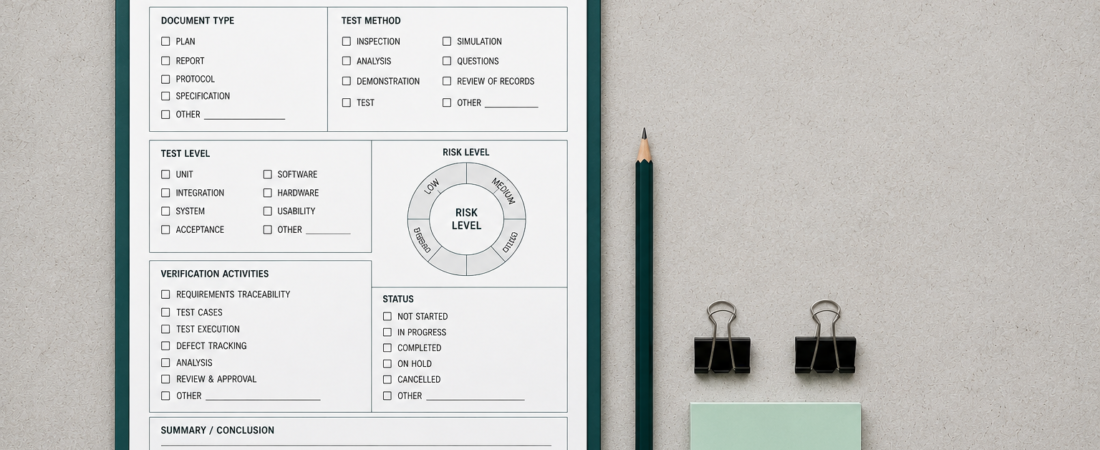
Download the free Lightweight SaMD Verification Checklist and use it as a practical guide for planning, preparing, executing, and reviewing your verification activities.
Keeping Workflows Practical
For Class A SaMD projects, documentation workflows do not always need enterprise-level complexity.
Many smaller teams benefit more from:
- lightweight processes,
- editable templates,
- and clear examples
than from highly formalised systems designed for large organisations.
Practical workflows are often easier to maintain consistently over time.
Templates as a Starting Point
Templates are most useful when treated as a starting framework — not as a one-size-fits-all solution.
Every software product, development team, and quality process is different. Good templates should be:
- adaptable,
- editable,
- and flexible enough to evolve alongside the project.
Final Thoughts
Good documentation templates are not just about saving time.
They can help small SaMD teams create:
- clearer workflows,
- more consistent verification activities,
- and more manageable software development processes.
The goal is not to add unnecessary process — but to reduce friction so teams can focus on building reliable software.