
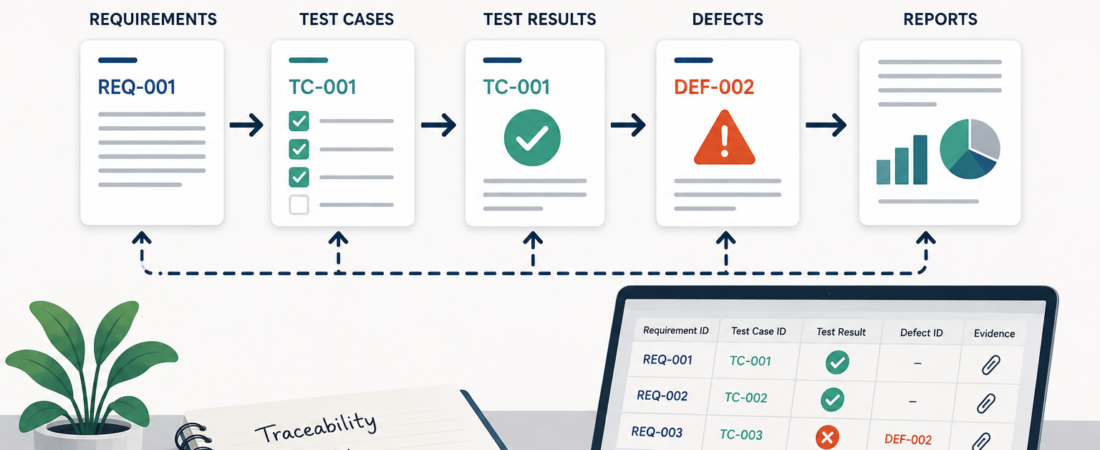
Requirements traceability is one of those concepts that almost everyone agrees is important, but far fewer teams find easy to implement in practice.
At the start of a project, traceability often feels unnecessary. There may only be a handful of requirements, a small number of tests, and a team that communicates frequently. It is usually easy to answer questions like “Has this feature been tested?” or “Where is the evidence for this requirement?”
As projects evolve, those answers become harder to find.
Requirements change. Features are refined. Test cases multiply. Defects are discovered and resolved. What once existed as shared knowledge within a small team gradually becomes harder to reconstruct from memory alone.
This is where traceability becomes valuable.
What Is Requirements Traceability?
At its simplest, requirements traceability is the ability to follow a requirement through its lifecycle.
In software verification activities, this often means maintaining links between:
Requirements → Test Cases → Execution Results → Defects → Reports
These relationships help teams answer important questions:
- Has every requirement been verified?
- Which tests support a particular requirement?
- What evidence exists for a verification activity?
- Were any defects identified during testing?
Traceability is not simply documentation for documentation’s sake. When implemented well, it provides visibility into what has been built, what has been tested, and where supporting evidence can be found.
Why Traceability Becomes Difficult
In my experience, traceability doesn’t usually fail because teams don’t understand its value. It fails because maintaining links between requirements, tests, and evidence feels like a lot of additional work during development.
This is particularly true for startups and small SaMD teams.
Early development often prioritises rapid learning and iteration, and requirements evolve as the product matures. Verification activities often lag behind implementation, and documentation that feels unnecessary early in a project can become essential later.
Unfortunately, reconstructing those relationships retrospectively is usually much harder than capturing them as work progresses.
I’ve found that the effort required to rebuild traceability after the fact is almost always greater than expected.
Keeping Traceability Lightweight
The good news is that effective traceability doesn’t always require specialised tools or complex processes.
For many Class A medical device software projects, relatively simple approaches can provide significant value:
- Assign unique identifiers to requirements.
- Link test cases directly to requirement IDs.
- Reference defects from failed tests.
- Capture evidence as verification activities are performed.
Even lightweight workflows can make it substantially easier to understand coverage and generate verification reports later.
The goal is not to create unnecessary process overhead. It is to establish structures that are practical, maintainable, and appropriate for the size of the team using them.
Traceability Is Easier to Build Than It Is To Rebuild
One lesson I’ve encountered repeatedly is that traceability is easiest to establish early and hardest to retrofit later.
When requirements, tests, and evidence are linked as work progresses, verification activities tend to remain manageable. When those links are deferred, teams often find themselves revisiting historical decisions, searching through old notes, or reconstructing relationships that were once obvious.
None of this is impossible. It is simply more time-consuming than most teams expect.
While standards such as IEC 62304 describe expectations around software verification activities, each organisation must implement processes appropriate to its products and quality system.
The Challenge of Rebuilding Relationships
One lesson I’ve learned from rapid prototyping projects is that traceability is rarely difficult because the information does not exist. Usually, it becomes difficult because the relationships between pieces of information were never captured.
As requirements evolved and features changed, development moved quickly and documentation naturally lagged behind. When it later came time to formalise verification activities, the challenge was not understanding how the software worked—it was reconstructing how everything connected.
Which requirement did this test verify? Was this defect already addressed? Which evidence supported this behaviour?
Individually, these questions were usually answerable. Collectively, they represented a significant amount of work.
The experience reinforced an important lesson: even lightweight traceability established during development is far easier to maintain than reconstructing relationships retrospectively. Small practices such as assigning requirement IDs and linking tests as they are created can save considerable effort later.
Final Thoughts
Perfect traceability from day one is rarely realistic.
However, even simple structures established early can significantly reduce effort later in verification activities. A requirement ID, a linked test case, or a captured piece of evidence may seem minor at the time, but collectively these small practices make verification easier to manage as projects grow.
The objective is not perfect documentation. It is maintaining enough visibility that teams can understand what was built, how it was verified, and where the supporting evidence resides.